 UKLakeDistrict
Force Falls, Grizedale
Waterfall Walk · Grizedale Forest · Satterthwaite
A circular walk through Grizedale Forest, its sculptures and Satterthwaite village to the hidden cascade of Force Falls. Free GPX, parking and tips.
Route map & downloads
Loading the interactive route map…
Map not included: carry OS Explorer OL7 and a compass.
- Start / parking
- Blind Lane Car Park
- Postcode
- LA12 8LN
- Grid ref
- SD 344 912
- Parking
- Free
Step-by-step route
The Force Falls walk is one of the Lake District's best-kept secrets — a circular ramble through the ancient woodland of Grizedale Forest that saves its finest moment for last: the white-water cascade of Force Falls, where Rusland Beck crashes down through the trees beside a 17th-century mill. This is a walk of three rewards rolled into one outing. There is the forest itself — oak, birch and larch threaded with green-and-white waymarked trails, home to red kites, red squirrels and the occasional pine marten. There are the famous Grizedale sculptures, more than forty works of art hidden among the trees, including the much-loved wooden bathers of the Cold Shower piece. And there is the quiet human history of the valley: the tiny village of Satterthwaite, the country churches of All Saints and St Paul's Rusland, and Force Mill, a Grade II listed corn-and-bobbin mill that once powered an iron-making forge at the foot of the falls. It's a moderate half-day walk that blends natural spectacle, industrial heritage and open-air art — a proper Lakeland adventure well off the honeypot trail.
Through the Forest to Satterthwaite
Set off from Blind Lane car park by turning away from the lane and taking the trail that climbs to your right, following the posts marked in green and white. Before long this feeds onto a broader forest road, where you bear left. The road later doubles hard back on itself to the right; at that point, with a grassier track leading off to the left, carry straight on instead onto a slim path that threads away into the trees. This is Grizedale at its most characteristic — oak, birch and tall larch overhead, sunlight dropping in bright columns through the leaves, and birdsong on every side. It's worth pausing to scan the treetops for a red kite, its forked tail unmistakable; thirty birds were released here in 2010 and their descendants now quarter these woods daily. Eventually the little path hardens underfoot and turns into a metalled lane, easing you downhill into the hamlet of Satterthwaite.
Satterthwaite Village & the Forest Tracks
The lane delivers you to All Saints Church on the edge of the village. Go left here along the road, and a short way on — just past Satterthwaite Bridge — swing right onto a rougher track heading uphill. Satterthwaite itself is a handful of stone cottages and little else, wonderfully sleepy, with the Eagle's Head as its one pub (do check it's open before pinning your hopes on a post-walk pint). Roughly 150 metres up the track, look for green-topped marker posts and fork left to follow them; where the path divides again, faint and easily misread, keep left once more. The trees crowd in more tightly through this stretch and the going turns softer — and, after a wet spell, decidedly muddy — a plain reminder that Grizedale is a working forest first and a beauty spot second.
Sculptures & the Woodland Climb
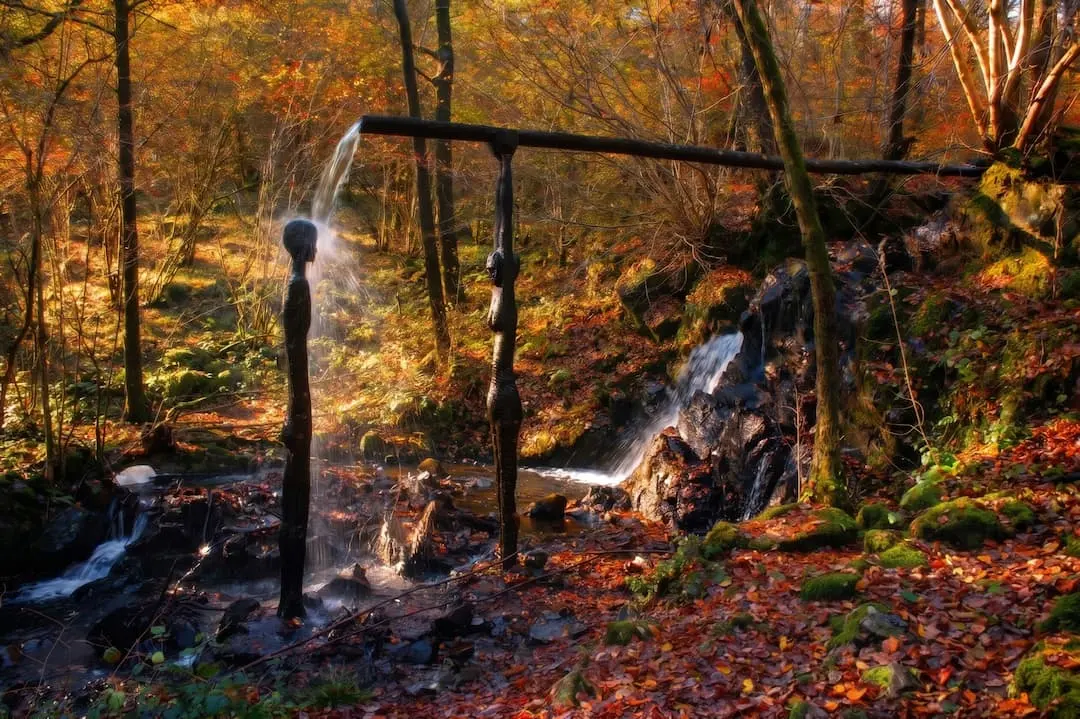
A right turn puts you on a wide forest track, and within a few minutes comes one of the forest's best surprises: two carved wooden figures seated beneath a little cascade — the much-photographed Cold Shower sculpture. It's just one of the forty-odd works dotted through these woods, part of a sculpture trail that has run here since 1977, among the oldest in the country. Follow the track as it curves left and lifts uphill; at the junction near the top, turn left, then count off roughly 250 metres and watch closely for a faint path slipping along just beneath the main track — the kind of turning you'll stride past entirely if your mind wanders. This whole section is Grizedale in miniature: a place where art and woodland are woven together on purpose, and a wooden face may be quietly regarding you from among the ferns.
Force Beck & the Coppice Woods
Meeting a minor road, turn right along it; some 100 metres on, slip through a gap between buildings on your left and bear right through a wide gate. As the next gate comes up, veer left to cross Force Beck on a footbridge and pass into a coppice beyond another gate. Woods like these were worked on rotation for centuries, their regrown poles feeding the local trades in charcoal, wooden bobbins and tanning bark. Fifty metres in, turn right onto a track; once through a tall gate, leave a muddy path on your left well alone and instead fork left onto a signposted trail, passing through a break in the wall. A brief pull uphill follows, the path bending right at the top before you fork left again — this turning, too, is easy to miss — and drop down the far side. Tread carefully through here: tangled roots and churned mud make it the most awkward footing of the walk.
Rusland Valley & the Climb Back
Join a minor road and turn left, passing close by St Paul's Church, Rusland, a plain and restful country chapel that rewards a short halt. Buried in its churchyard is Arthur Ransome, who wrote Swallows and Amazons and was devoted to this quiet fold of the southern Lakes. When you come level with a lane branching off to the right, take the turning to the left instead, onto a rough track that climbs steadily with a wall running along its left-hand side. The dense forest loosens its grip here, opening into gentler, more farmed country — long views over the Rusland valley, hedge-lined fields and grazing sheep — a calmer interlude before the walk saves its best for last.
Force Falls & the Return
When you reach a road, turn right and let it curve you round to the left, rising now beside the walk's headline act — Force Falls. Known too as Rusland Force, this is the point where Rusland Beck spills in a run of white cascades through the trees, at its most powerful a day or two after heavy rain, when spray hangs in the air and the noise fills the wood. Directly below sits Force Mill, the old bobbin mill — a Grade II listed building that in its time ground corn, turned bobbins for the cotton trade and drove a bloomery forge for smelting iron, and which survives today as a private house. Above the falls, pick up the green-and-white waymarkers again by turning right and keeping right at the fork. Around 70 metres past a wall you cross back over it to the right, then head down through the trees to close the loop at Blind Lane car park — a fine circuit that holds its best sight back until almost the final moment.
Route Essentials
- Parking: Start from Blind Lane car park, a small, free Forestry Commission car park near Force Mills (grid ref SD 344 912, postcode LA12 8LN), about 2½ miles south of Grizedale Forest Visitor Centre. Spaces are limited, so arrive early in peak season and at weekends.
- Terrain: A mix of forest roads, narrow woodland trails, minor lanes and rough tracks, with around 284 m of ascent spread over gentle climbs. It's muddy in places, especially after rain — sturdy walking boots are strongly recommended, and there is some road walking through Satterthwaite and near Rusland.
- The sculptures: Grizedale Forest is home to 40+ outdoor sculptures, part of a trail running since 1977. The route passes the Cold Shower bathers below a small waterfall — but keep your eyes open, as many pieces blend quietly into the trees and are easy to miss.
- Historical interest: Force Mill at the base of the falls is Grade II listed. Built as a corn mill, it later became a bobbin mill and powered a bloomery forge for the local iron industry. Nearby, St Paul's Church at Rusland is the burial place of author Arthur Ransome.
- Wildlife: Watch for red kites (re-introduced in 2010), red squirrels, dormice and the elusive pine marten. Listen for woodpeckers among the trees and scan the sky for the red kite's distinctive forked tail.
- Safety Notice: The GPX file and route information on this page are for general guidance only. Always carry an OS map and compass, check the weather forecast, and tell someone your plans before setting out. You walk at your own risk.
Enjoyed this gentle woodland cascade? Grizedale is just one of several waterfall walks in our collection. For the Lake District's tallest fall, try the Scale Force walk from Buttermere; for a dramatic gorge in Eskdale, see the Stanley Ghyll Force walk; for a hidden gem above Great Langdale, there's the Whorneyside Force walk; and for Ullswater's best-loved cascade with an optional fell circuit, take the Aira Force and Gowbarrow walk. Every route lives on our Lake District waterfalls hub.
Gallery
What to Bring
- Sturdy walking boots (muddy forest tracks)
- Waterproof jacket
- Waterproof trousers
- Water bottle
- Snacks or a packed lunch
- OS Explorer OL7 (The English Lakes — South-eastern area)
- Phone with the OS Maps app
- Camera (for the falls and sculptures)
- Insect repellent (summer forest midges)
- Dog lead (livestock and ground-nesting birds)
Best Time to Visit
Force Falls is at its most spectacular after heavy rain, when Rusland Beck is in full spate and the cascade thunders through the woods — so the wetter months of autumn, winter and early spring often show it at its best. Spring and autumn strike the best balance of good flow and comfortable walking, with the forest either fresh with new leaf or turning gold. Summer brings the longest days but also midges in the shadier, damper stretches of the forest, so pack repellent. Winter can leave the tracks very muddy and slippery underfoot, so choose your day and your footwear with care.
Local Weather (yr.no)

Forecast provided by yr.no
Safety Information
Important: The GPX file and route description on this page are for general guidance only and should not be relied upon as a sole means of navigation. GPX tracks are approximate and may not reflect current ground conditions, path diversions, or seasonal changes.
Always carry an Ordnance Survey map and a compass, and know how to use them. Check the weather forecast before setting out, tell someone your planned route and expected return time, and wear appropriate footwear and clothing for the conditions. In an emergency dial 999, ask for the Police, then Mountain Rescue. Read our fell safety guide before your first walk.
UKLakeDistrict.com accepts no responsibility for any loss, injury, or damage arising from the use of route information or GPX files provided on this site. You walk entirely at your own risk.
Grizedale Forest: History, Wildlife & Things to Do
From hunting forest to sculpture trail
Grizedale Forest covers the high ground between Coniston Water and Windermere, and it has been worked by people for centuries. In medieval times it belonged to the monks of Furness Abbey, who grazed livestock and managed the woods for timber and charcoal. The Forestry Commission bought the estate in the 1930s and planted the conifers that now make up much of the forest, alongside surviving pockets of older oak and birch.
During the Second World War, Grizedale Hall — a large mansion near the present visitor centre — became a prisoner-of-war camp for captured German officers, many of them U-boat and Luftwaffe crew, earning it the nickname "the U-boat Hotel". The hall was demolished after the war, but the story remains one of the forest's more surprising chapters.
In 1977 the forest became a pioneer of outdoor art when the Grizedale Society began inviting artists to make work in and from the landscape. Early contributors included Andy Goldsworthy and David Nash, and the collection has grown to dozens of pieces scattered along the trails. Some are monumental, others deliberately hidden, and many are made from natural materials designed to weather slowly back into the forest.
Charcoal, bobbins and bloomeries: the working woods
The valleys around Force Falls were once a hive of woodland industry. Coppiced oak, hazel and birch were cut on a rotation of 15–20 years and turned into charcoal to fuel the local iron bloomeries, into bark for tanning leather, and into swill baskets woven from oak strips. As you walk through the Rusland valley, look out for flat, circular platforms in the woods — these are old charcoal-burning pitsteads, where colliers once lived for weeks tending their smouldering stacks.
The water-powered mills at Force Forge and Force Mill are part of the same story. By the 19th century many local mills made wooden bobbins for the Lancashire cotton industry. To see how it worked, visit Stott Park Bobbin Mill near Lakeside, a short drive south — a preserved working mill run by English Heritage.
Red kites, red deer and red squirrels
Grizedale is one of the best wildlife woodlands in the Lake District. Red kites were reintroduced here from 2010 and are now a regular sight over the forest — look for the forked tail and the slow, buoyant, circling flight. The forest also holds a population of native red deer and smaller roe deer; dawn and dusk give the best chance of a sighting, and in autumn you may hear stags roaring during the rut.
Red squirrels still hold on in the forest, supported by local conservation groups working to keep grey squirrels out, and the woods are home to pine martens too — though these are rarely seen. Walk quietly, keep dogs close, and pause in clearings to watch and listen.
Things to do in and around Grizedale
The Grizedale visitor centre, a couple of miles north of the start, has a café, toilets, bike hire and the start of several waymarked walking and cycling trails. Families can take on the high ropes at Go Ape, and mountain bikers come for the forest's graded trails. The village of Satterthwaite, on this route, has a traditional pub, and the historic village of Hawkshead — with its Beatrix Potter Gallery and the grammar school Wordsworth attended — is a short drive north.
Author Arthur Ransome spent his later years in this corner of the Lakes, and he and his wife Evgenia are buried in the peaceful churchyard of St Paul's, Rusland, passed on this walk.
Getting there and nearby walks
Grizedale has no regular bus service, so most visitors drive; the forest roads are also popular with cyclists coming over from Hawkshead or from the Windermere ferry. Parking at the small Blind Lane car park is limited, so arrive early at weekends.
This walk combines well with other gentle outings in the southern Lakes. Our Gummer's How walk gives a huge Windermere view for very little effort, the Tarn Hows and Tom Gill circular is a short drive west, and Black Crag adds a Wainwright summit to the Tarn Hows scenery. For more cascades, see all our Lake District waterfall walks.
Guide last updated .
Frequently Asked Questions
Where is the best place to park for the Force Falls walk?
The best parking is Blind Lane car park, a small free Forestry Commission car park near Force Mills (grid ref SD 344 912, postcode LA12 8LN), which sits right at the start and finish of this circular route. It's around 2½ miles south of the Grizedale Forest Visitor Centre. Spaces are limited, so it pays to arrive early in summer and at weekends.
How long does the Force Falls Grizedale walk take?
Allow around 2.5 to 3 hours for the full circular route. It measures roughly 6.9 km (4.3 miles) with about 284 m of ascent according to our GPX track, taken at a relaxed pace with time to enjoy the sculptures, the villages and the falls. Add extra time if the ground is muddy or if you stop for photos and a picnic along the way.
Is the Force Falls walk suitable for children and families?
Yes — it's a moderate, family-friendly walk that older children who are used to walking will enjoy, not least for the fun of spotting Grizedale's outdoor sculptures hidden among the trees. The climbs are gentle rather than steep, but the paths are muddy and uneven in places and there is some road walking, so it isn't suitable for pushchairs. Sturdy footwear and a sense of adventure are all you need.
Can you swim at Force Falls in the Lake District?
Force Falls (also called Rusland Force) is a steep, rocky cascade rather than a gentle bathing pool, and the water is fast, cold and shallow over rock — it is not a safe or recommended spot for swimming, especially after rain when the beck is in spate. Enjoy the falls from the path, take your photos, and save wild swimming for one of the Lake District's calmer tarns or lakes.
What is the history of Force Mill at Force Falls?
Force Mill (the Old Bobbin Mill) stands at the foot of the falls and is a Grade II listed building. Originally a corn mill, it was later converted to turn wooden bobbins for the Lancashire cotton industry and also powered a bloomery forge for local iron-making — the waterfall provided the power. The building survives today, now in residential use, and is a tangible link to the valley's working past of milling, coppicing and iron.
Are dogs allowed on the Force Falls walk?
Yes, dogs are welcome but should be kept on a lead for the whole route. There is livestock in the fields around Satterthwaite and Rusland, and Grizedale Forest is home to ground-nesting birds and other sensitive wildlife. Keeping your dog on a lead protects them, the wildlife and grazing animals, and keeps you on good terms with the farmers whose land the route crosses.
What sculptures can you see on the Force Falls Grizedale walk?
The route passes the well-loved Cold Shower sculpture — two wooden bathers sitting below a small waterfall — but that is just one of more than 40 outdoor artworks in Grizedale Forest. The forest has hosted a sculpture trail since 1977, one of the oldest in Britain, with pieces made from wood, stone and metal deliberately sited to blend into the landscape. Half the fun is spotting the ones you weren't expecting.
Is there a pub near the Force Falls walk?
The traditional post-walk pub is the Eagle's Head in Satterthwaite, the village you pass roughly a third of the way round the route. It's a proper country local — though it's worth checking its current opening hours and status before you set out, as rural pubs can change hands. For a wider choice, the Grizedale Forest Visitor Centre and the villages around Hawkshead are a short drive away.
Nearby walks

Gummer's How
Gummer's How walk: a 2.7 km family-friendly climb from a free Forestry England car park to a 321 m summit above Windermere. Route map, free GPX and tips.
Read guide: Gummer's How →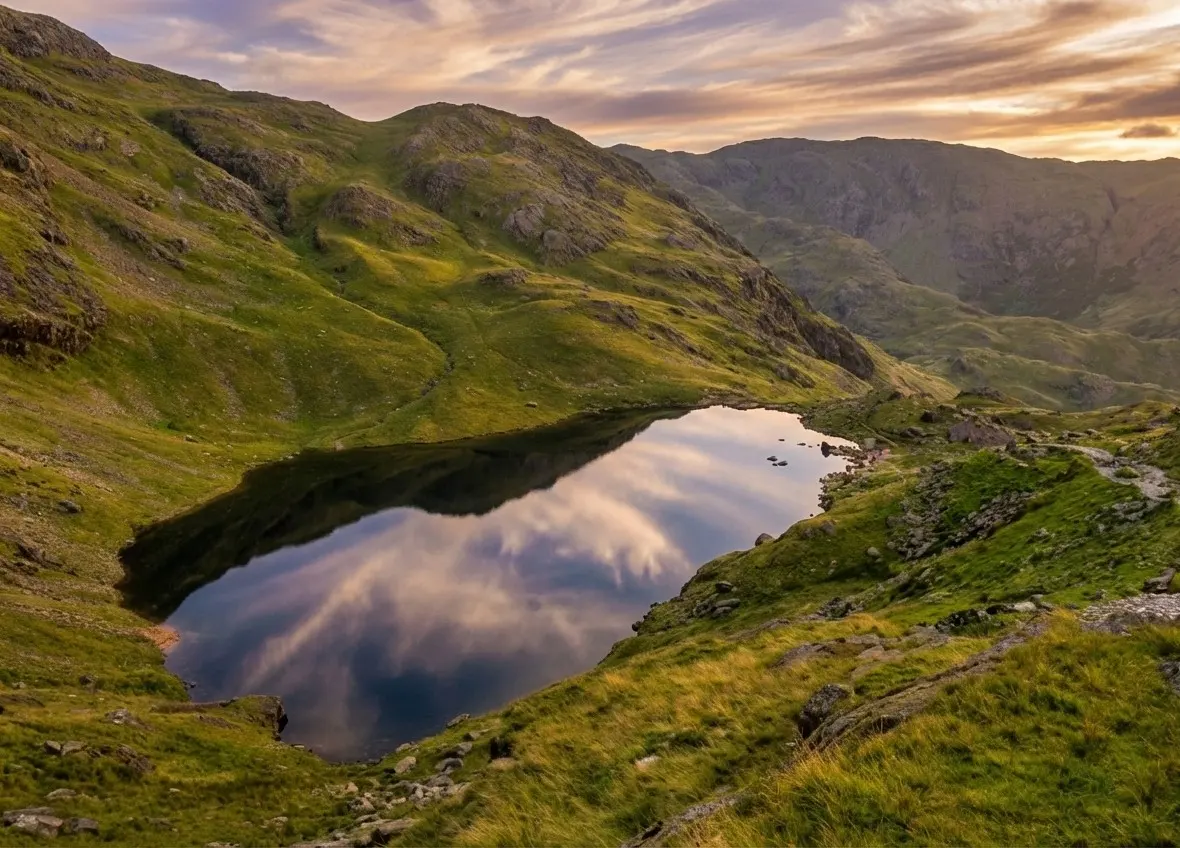
Old Man of Coniston
Old Man of Coniston circular walk: 8.1 km and 3.5–5 hours via Low Water and Goat's Water, with route map, free GPX, car park, difficulty and summit facts.
Read guide: Old Man of Coniston →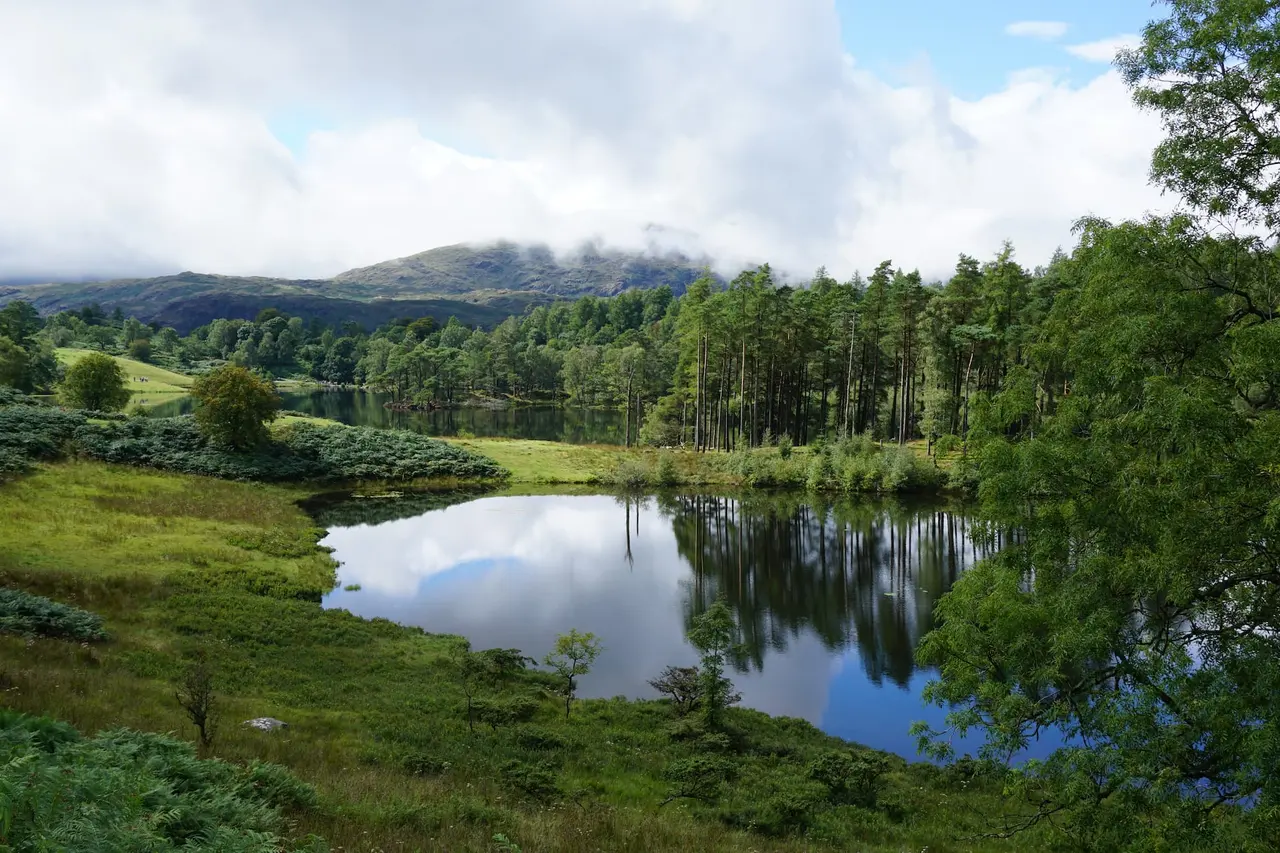
Black Crag & Tarn Hows
A circular walk linking the Tom Gill waterfalls, Tarn Hows and the Wainwright summit of Black Crag above Coniston. Free GPX, parking and timings.
Read guide: Black Crag & Tarn Hows →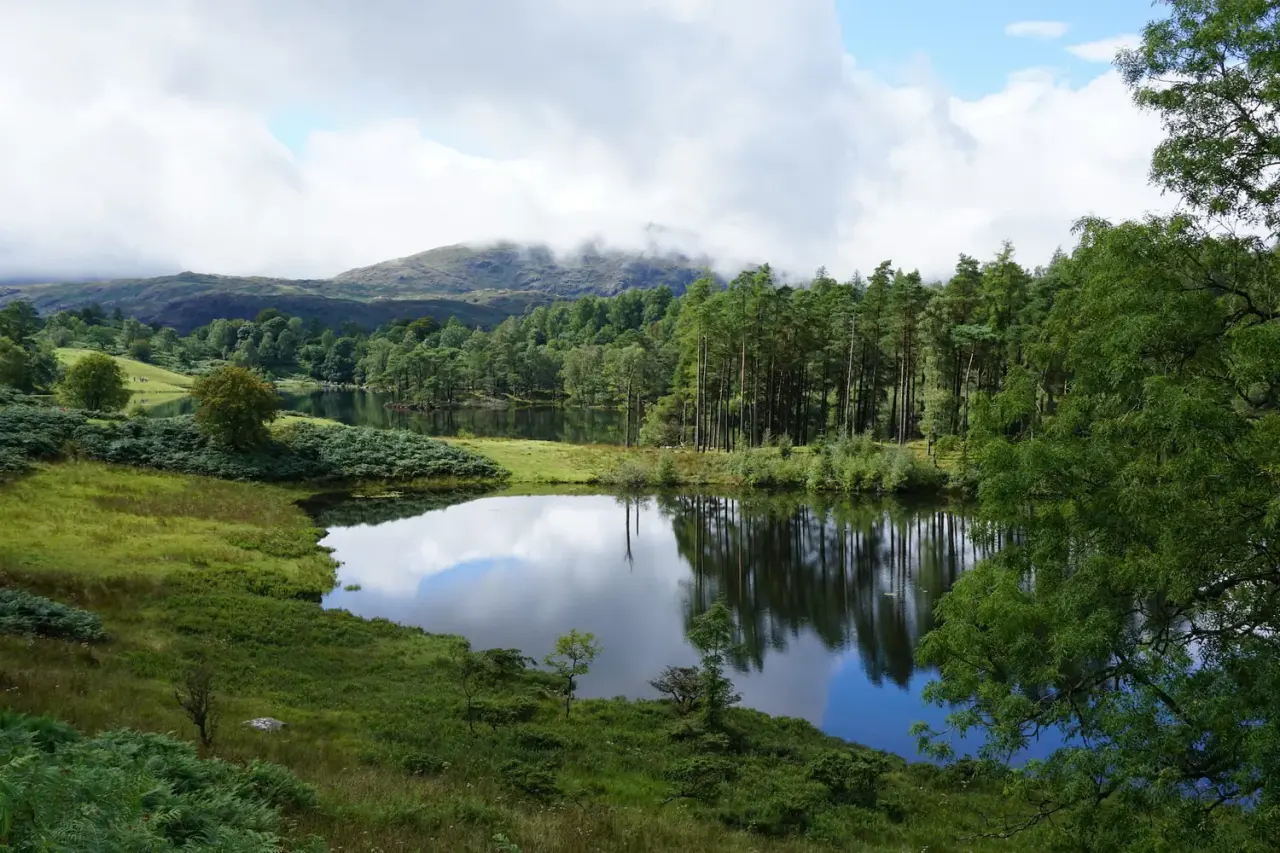
Tarn Hows & Tom Gill
A short Coniston circular via the Tom Gill waterfalls to Tarn Hows, with an OS map, free GPX download and honest parking and accessibility info.
Read guide: Tarn Hows & Tom Gill →More walks in Coniston & Hawkshead →
Similar walks elsewhere

Stanley Ghyll Force
Walk from Dalegarth Station through a rhododendron gorge to Stanley Ghyll Force, a 60ft waterfall with a cantilevered viewing platform. Free GPX.
Read guide: Stanley Ghyll Force →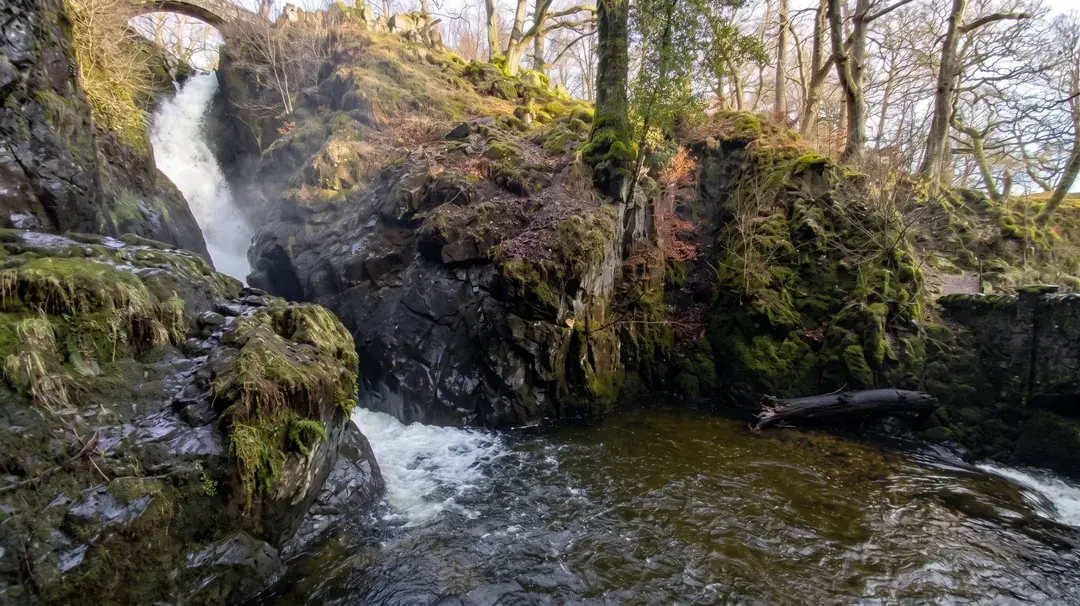
Aira Force & Gowbarrow
Discover the 65ft Aira Force waterfall and the full Gowbarrow Park circular walk, with interactive OS maps, free GPX downloads and parking info.
Read guide: Aira Force & Gowbarrow →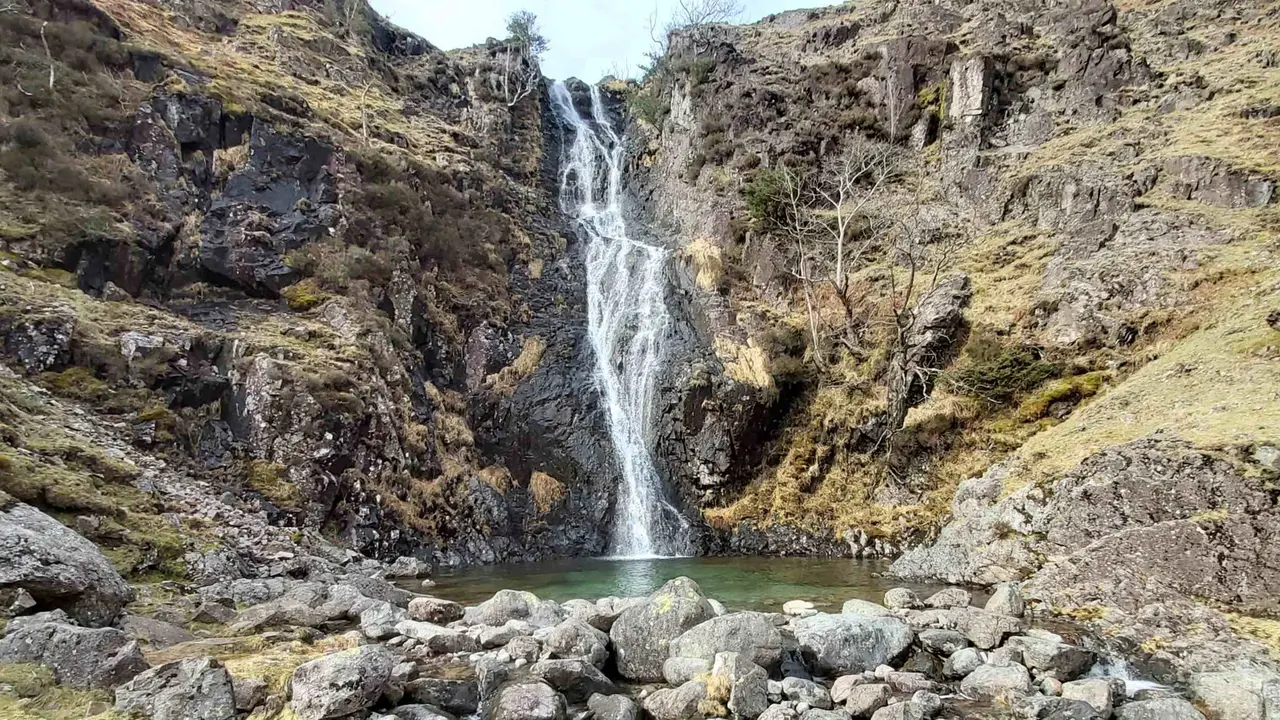
Whorneyside Force
A quiet route from the Old Dungeon Ghyll up Oxendale to a hidden Langdale waterfall, ending at a legendary hikers' pub. Free GPX, parking and tips.
Read guide: Whorneyside Force →